Project
ESI Global
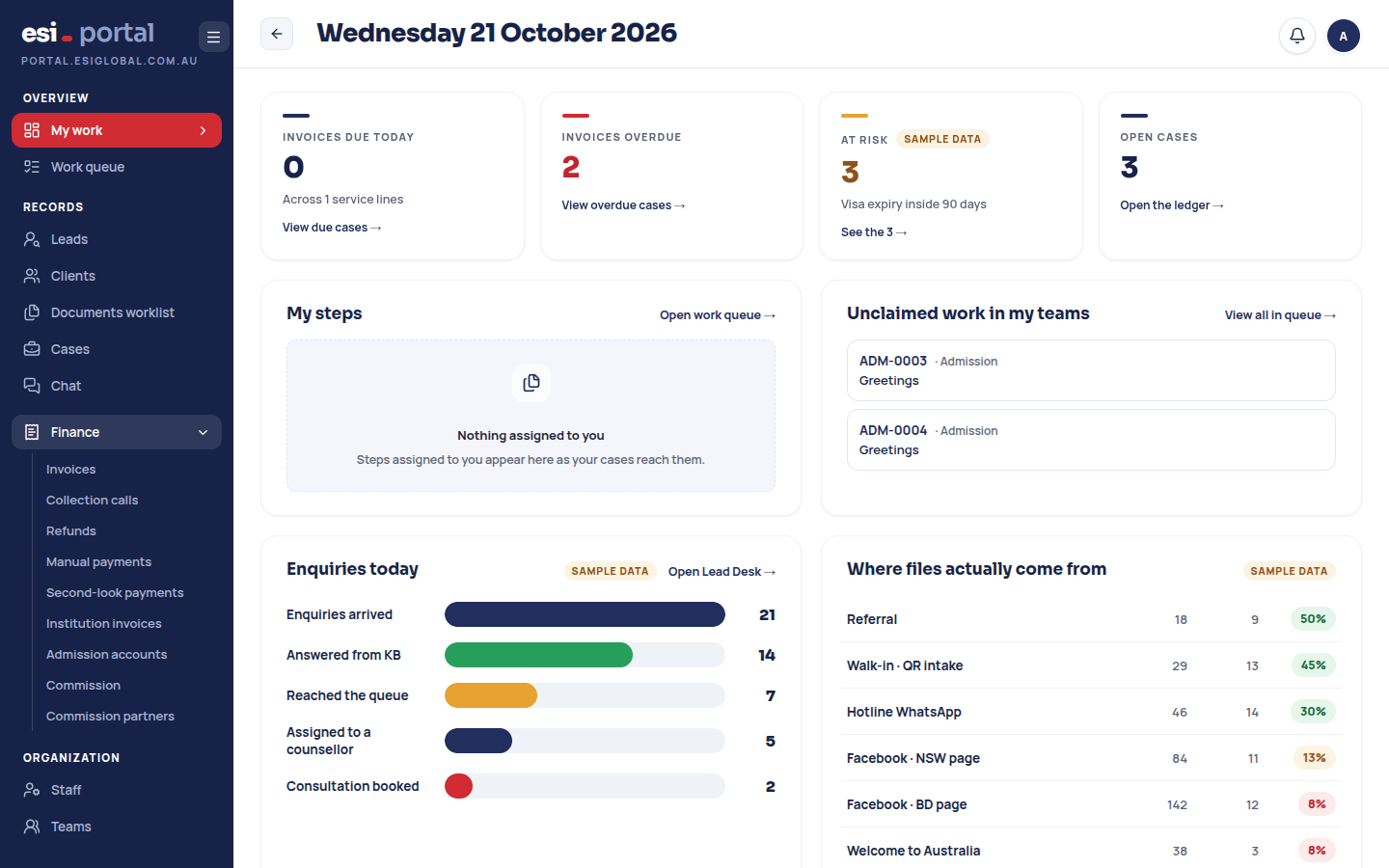
An operations platform for a migration consultancy, bringing case workflows, client communication, payments, and staff tools together.
Features
01Marketing site
The marketing site is 17 Astro pages that stay readable with JavaScript off, while the contact and QR enquiry forms post straight to the API
JSON-LD schema and copy written for answer engines, with per-page SEO and a no-JS check running in CI
An embedded chat widget and a renderer for policy documents
02Staff portal
A lead pipeline that captures enquiries, flags duplicates, enforces status transitions, imports CSVs in partial batches, and hands staff a distribution panel
A client CRM built around one record per client across five branches, covering phases, consent, notes, and timelines
The case workflow engine carries versioned stage templates with SLAs, payment-clearance gates that fail closed against the real invoice ledger, and compare-and-set task transitions
Work queues and role dashboards, materialised ahead of time for the document team and submission officers
A checklist and document vault with authority templates, rejection recordings, expiry sweeps, and ZIP export whose access gets audited
Service agreements run on versioned templates with signature capture and PDF export that embeds its fonts
Operational admin covers branches, teams with managed scoping, staff management, and versioned trade rules
03Client portal (/my)
Case progress shown as phase steps, with checklist items to upload
Documents, agreement viewing and signing, invoices, and payments
Per-case chat with media and voice notes, kept behind a consent gate that cannot be skipped
04Chat & calls
Case and client chat rooms keep staff whispers isolated, with reactions, read markers, and presence
Voice notes that know who has listened, plus message search and daily email digests
LiveKit audio huddles come with ringing and active-state exclusivity, attendance reconciliation, and call logs with summaries
Delivery runs over WebSockets on top of durable notifications, with Postgres LISTEN/NOTIFY bridging processes
05Finance
An invoicing engine runs per-case and global sequences, handles AUD as a single currency, and gets the GST maths right
Public Stripe Checkout links at /pay/:code that know how to expire and how to say no
Stripe Connect webhooks on both the platform and linked accounts, verified against the raw request body
Refunds anchored to cooling-off windows and held to an approval scope
Manual payments across several money accounts, with payment promises, dues call lists, and statements
A commission engine for partners, versioned terms, enrolment instalments, and settlements that lock while they run
Admission accounts keep tuition separate from agency income, with institution payments on an audit trail
Partner invoices go to institutions with multi-attempt delivery and PDF rendering
06Backend & infra
The Fastify API runs on a shared TypeBox contract that serves as both runtime validation and the portal permission matrix
One login covers staff and clients: signed session cookies, a scrypt password policy with lockout, and invalidation by session epoch whenever a password resets
Every sensitive action lands in an append-only audit ledger, redacted where it should be and cursor-paged so it stays quick to read
BullMQ sweeps run on bare PostgreSQL with no Redis involved: follow-ups, expiry, refunds, and checkout expiry
A single Cloudflare Worker serves the static site, the portal, and the reverse-proxied API from one origin
Documents live in S3, guarded at boot so a staging deploy pointed at the production bucket refuses to start
07Engineering
A Vitest suite of 379 API test files, from journey-level specs to migration-immutability and webhook-signing checks
CI carries a coverage ratchet, the no-JS site gate, and Playwright journeys through the portal
Staging deploys happen automatically; getting into production requires four green checks first